



Here is a comprehensive markdown note example featuring De Morgan’s Laws, demonstrating advanced Markdown syntax including LaTeX mathematical equations, Mermaid logic diagrams, tables, and text highlighting. You can directly view the layout and reference its source:
De Morgan’s Laws
Abstract: De Morgan’s laws are fundamental transformation rules in formal logic, set theory, and Boolean algebra relating logical conjunctions/disjunctions (AND, OR) through negation (NOT, complement).1
1. Core Mathematical Formulations (LaTeX)
De Morgan’s laws share an identical theoretical core across mathematical domains:
🔹 Propositional Logic
In formal logic, they express duality between AND and OR under negation:
🔹 Set Theory
In set theory, they describe the duality of intersection and union under complements:
(where denotes the complement of set )
🔹 Boolean Algebra / Digital Circuits
In computer hardware and digital circuit design, an overline represents NOT, a dot indicates AND, and a plus sign indicates OR:
2. Truth Table Verification (Table)
We can rigorously verify the first law with a truth table:
| Input | Input | (AND) | (NAND) | (NOT P) | (NOT Q) | |
|---|---|---|---|---|---|---|
| T | T | T | F | F | F | F |
| T | F | F | T | F | T | T |
| F | T | F | T | T | F | T |
| F | F | F | T | T | T | T |
💡 Conclusion: Columns 4 and 7 exhibit identical truth values across all states, proving logical equivalence.
3. Equivalent Logic Gates (Mermaid)
In electronic engineering, De Morgan’s laws simplify integrated circuits. This flowchart demonstrates how a NAND Gate equates to an active-low Negative-OR Gate:
graph LR
    subgraph Left: NAND Gate
        A[P] --> C((AND))
        B[Q] --> C
        C --> D((NOT))
        D --> E["Output: ¬(PQ)"]
    end

    subgraph Right: Negative-OR Gate
        F[P] --> G((NOT))
        H[Q] --> I((NOT))
        G --> J((OR))
        I --> J
        J --> K["Output: ¬P∨¬Q"]
    end

    E -. "Logically Equivalent" .-> K

    style E fill:#f9d0c4,stroke:#333,stroke-width:2px
    style K fill:#d0f9c4,stroke:#333,stroke-width:2px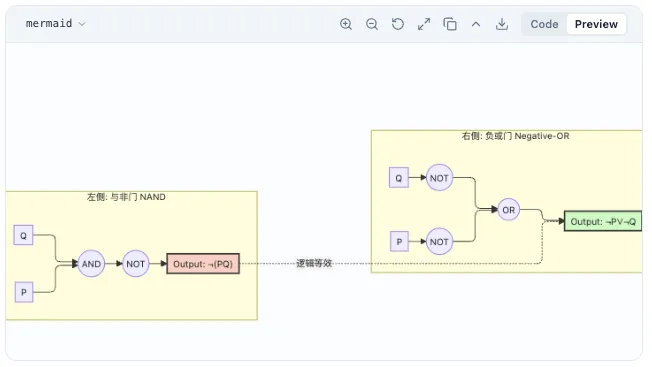
4. Mnemonics & Heuristics
- “Break the line, change the sign”: In Boolean algebra, breaking the continuous NOT bar transforms AND into OR, and OR into AND.
- “Negate parts, flip operator”: Distribute negation to individual components while flipping the connective.
- Core Axiom: “Negating a whole equals negating each part individually with flipped connectors.”
5. Practical Use Cases
- Software Engineering & Condition Simplification:
Complex
ifconditionals simplify cleanly with De Morgan’s laws.- Original:
if (!(user.isLoggedIn() && user.hasPermission())) - Simplified:
if (!user.isLoggedIn() || !user.hasPermission())(cleaner readability)
- Original:
- Database Query Optimization:
In SQL queries,
NOT (A AND B)simplifies toNOT A OR NOT B, allowing query optimizers to better utilize indices. - Natural Language Logic:
- “I do not like (apples and bananas)” is identical to “I do not like apples or I do not like bananas.”
6. Historical Context
Named after British mathematician and logician Augustus De Morgan (1806–1871), who introduced these relationships into formal symbolic propositional logic in his 1847 treatise Formal Logic.2
📝 Appendix: Markdown Syntax Features Used
- LaTeX Math Formulas (KaTeX): Inline
$...$and block$$...$$equations. - Mermaid Diagrams: Interactive vector circuit flowcharts.
- GFM Tables: Structured 7-column truth tables.
- Highlighting:
==highlighted text==tags. - Footnotes:
[^1]reference anchors.